
Starting July 1, every public school in Georgia serving students in kindergarten through eighth grade must have a policy in place restricting personal electronic devices during the instructional day.
The mandate — passed by the General Assembly during the 2025 legislative session and expanded in 2026 — requires what lawmakers have called a “bell-to-bell” restriction: from the moment students enter the building in the morning to the moment they leave in the afternoon, personal phones, smartwatches, and tablets must be stowed and inaccessible.
High schools have until July 1, 2027, to implement their own versions of the policy.
What it looks like in practice
Districts have flexibility in how they enforce the rule. Common approaches emerging across the state include:
- Phone pouches — lockable neoprene sleeves (such as Yondr pouches) that students carry but cannot open until they tap an unlocking station at dismissal
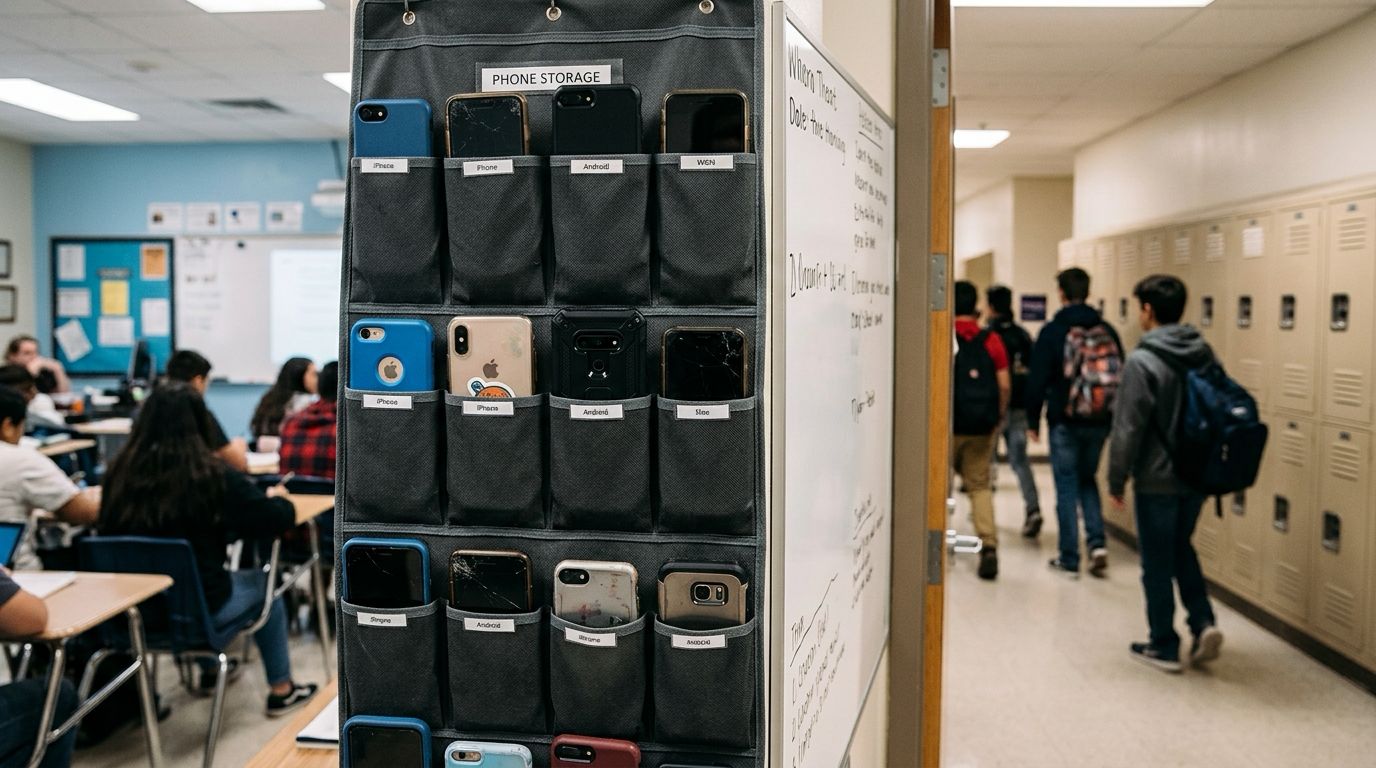
- Classroom collection bins — phones placed in numbered slots at the start of each period
- Locker storage — devices left in lockers for the duration of the school day
- “Off and away” policies — the simplest approach, where devices must be powered off and stored in a backpack at all times
Several metro Atlanta districts — including Atlanta Public Schools, Gwinnett County, and Cobb County — have already piloted variations of these approaches during the spring semester.
Why the change
The legislation was driven by growing evidence that phone use during school hours is linked to increased anxiety, reduced attention spans, and declining academic performance among adolescents. Georgia legislators cited data showing that the average middle-schooler checks their phone more than 40 times during a school day when access is unrestricted.
“We’re not anti-technology. We’re pro-learning. And the data is clear that unrestricted phone access during instruction time is harming learning.”
— State education official
Teachers overwhelmingly support the change. In a Georgia Association of Educators survey conducted this spring, 82 percent of respondents said unrestricted phone use was the single biggest classroom-management challenge they face.
What parents should know
- Emergency contact remains available. Every school must maintain an office phone line and a protocol for parents to reach students in an emergency. Students with documented medical devices (such as continuous glucose monitors that pair with phones) are exempt.
- Before- and after-school use is allowed. The restriction applies only during the instructional day.
- Consequences are progressive. Most district policies start with a verbal warning, escalate to confiscation for the day, and ultimately involve parent pickup of the device.
The high-school question
The 2027 deadline for grades 9–12 has generated more debate. High-school students are more likely to drive, hold after-school jobs, and need phones for legitimate purposes during the school day. Several districts are exploring hybrid approaches that allow phone access during lunch and passing periods but restrict it during instruction.
The Georgia Department of Education is expected to release best-practice guidance for high-school implementation by the end of the year.
Aisha Bell covers education and community affairs for WACN 21. Reach her at abell@wacn21.com.