
ATLANTA — Georgia’s next statewide voting system now has a calendar, a co-chair structure, and a blunt procurement warning.
Atlanta News First reported that the newly formed Election Equipment Specifications and Standards Committee met for the first time Friday at the State Capitol to begin redesigning the equipment every county must use. The bipartisan panel is charged with finding a replacement for the current touchscreen fleet, with a stated focus on transitioning toward hand-marked paper ballots in time for the 2028 elections.
Trust, time, and one uniform system
State Rep. Scott Holcomb (D-Atlanta), the sole Democratic lawmaker on the panel per ANF, put the politics in plain language: the committee exists because people have lost trust in the system. State Sen. Max Burns (R-Sylvania), the Senate co-chair, stressed that procurement, implementation, and training all take real calendar time — not a single bill-signing moment.
State Rep. Victor Anderson (R-Cornelia), the House co-chair, reminded members that Georgia is unusual: only a handful of states require one uniform voting system across every county. That legal design kills the option of letting a few counties pilot hardware while others wait. Whatever the panel recommends has to work in Fulton and in rural counties with very different staffing depth.
The $107 million hangover
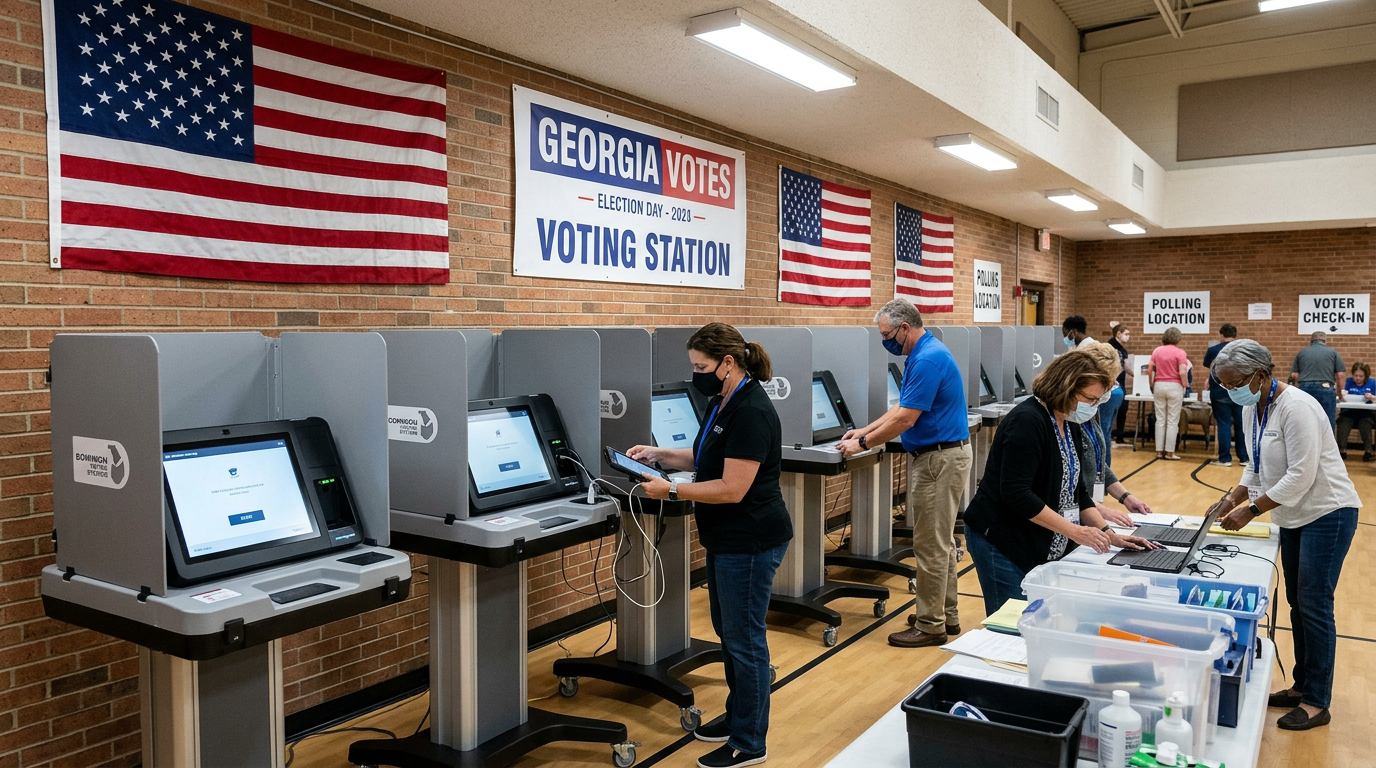
Complicating any “rip and replace” story is the cost of what Georgia already owns. ANF reported the state spent $107 million in 2019 on roughly 30,000 touchscreen machines. Holcomb said he is troubled that taxpayers are still paying off that purchase while lawmakers discuss jettisoning the equipment. That is a fiscal-politics problem layered on top of the technology debate: voters will ask why a decade-scale capital buy is being abandoned mid-amortization.
Procurement freeze risk
State purchasing experts delivered the committee’s most operationally important warning. Acquiring a new uniform system will take months under ordinary rules. A single vendor protest or lawsuit can trigger an automatic stay that freezes the entire process. For a panel already pointing at 2028, that is not a footnote — it is a critical-path risk. One contested award could erase a full election cycle of training and ballot-printing redesign.
Local election officials have also warned that fully hand-marked ballots can slow polling places and lengthen lines compared with ballot-marking devices. The committee will have to reconcile those throughput concerns with the political demand for paper that voters mark themselves.
The fall hearing slate
On Friday the committee unanimously approved operating rules and locked a fall schedule. ANF reported four public hearings to take expert and stakeholder testimony, with the first set for Sept. 3. The panel must submit a final recommended roadmap to the governor and General Assembly by January 2027 so lawmakers have time to draft and pass enabling legislation before the next full cycle.
That sequence matters: specifications first, statute second, procurement third, training fourth. Skipping any step to chase a slogan is how large IT projects miss Election Day.
What is and is not decided
Nothing about Friday’s meeting selected a vendor, a ballot style finalist, or a dollar figure for the next statewide buy. What it did establish is institutional ownership: a named bipartisan committee, a public hearing calendar, a January 2027 deliverable, and a shared acknowledgment that lawsuits and line-length tradeoffs are first-class constraints — not afterthoughts.
For metro Atlanta election workers and voters, the near-term watch items are the Sept. 3 hearing docket, any early consensus language around hand-marked paper versus hybrid systems, and whether the January 2027 report arrives with a funding path that does not pretend the 2019 machines were free.